Hello everyone, I am Nan Lei, the Brand Operations Manager at Haiber.
Many people ask me why I have such confidence in our company and the industry. Let me be completely frank with you: it is because we have the substance to back it up. In the amusement industry, safety is the bottom line, and professionalism is our source of confidence. It is precisely through such a professional team that Haibeier perfects every single detail. Moving forward, we will continue to leverage this professionalism to deliver amusement experiences that are safer, more entertaining, and infused with cultural warmth.
Walk into almost any children's play area and the slide is likely to attract attention. From a small toddler slide to a giant slide integrated into a multi-level structure, sliding combines movement, anticipation, and excitement in a simple activity.
Children can quickly understand how a slide works, yet they often want to use it repeatedly. This combination of simplicity and repeatability is one reason slides remain a favorite attraction in indoor playgrounds.
For commercial operators, an indoor playground slide is more than a recreational feature. It can connect different levels, encourage children to explore the facility, and become a visual focal point.
Sliding gives children an immediate sense of movement and speed. A short slide can provide a gentle introduction for younger children, while longer, curved, or enclosed designs can create a stronger sense of adventure.
Children do not need complicated instructions to enjoy a slide. Once they learn how to climb and slide, they can repeat the activity many times.
This repeatability makes slides particularly valuable in commercial play spaces where operators want attractions that remain engaging over time.
A slide usually forms part of a larger movement sequence. Children may climb stairs, platforms, nets, or bridges before reaching the top.
A well-planned slide indoor playground therefore encourages children to move through multiple areas instead of staying in one location.
Traditional straight slides remain popular, but modern playground design offers far more choices. Slides can now be enclosed, spiral-shaped, curved, circular, themed, or integrated into interactive structures.
This variety allows commercial playgrounds to create attractions that are both fun and visually distinctive.
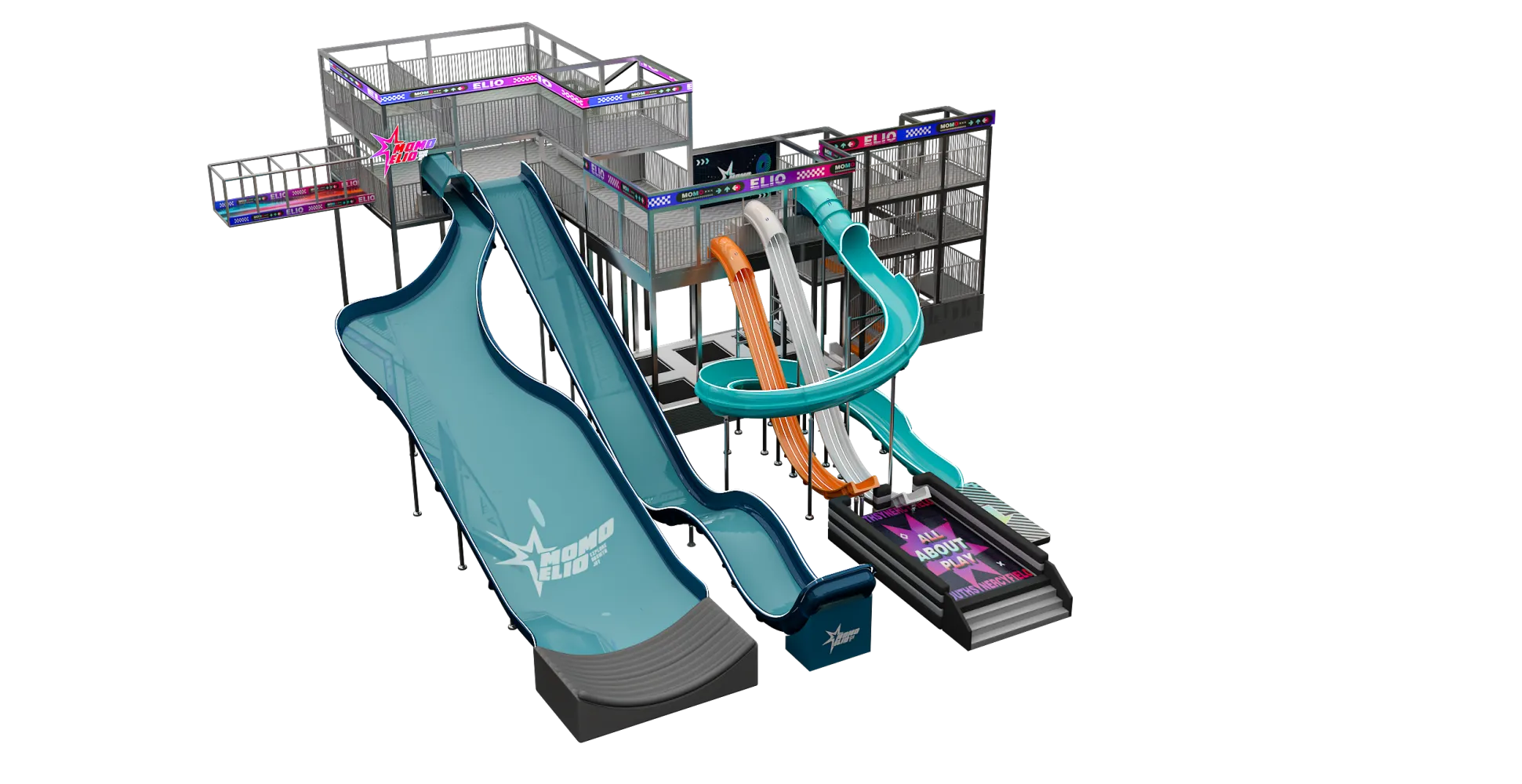
A giant slide can transform an ordinary play feature into a signature attraction. Greater height, longer routes, and unusual shapes can make a slide visible from different areas of a facility.
However, bigger is not automatically better. A large slide must match the building height, available floor space, circulation, target age group, and surrounding equipment.
A large indoor slide can deliver a strong sense of scale and excitement while being fully integrated into a commercial play structure.
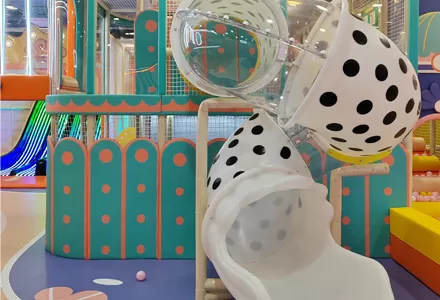
A tube slide playground creates a more enclosed experience than a conventional open slide. Children may not be able to see the entire route, making each turn more exciting.
A spiral tube slide can also make effective use of vertical space by creating a longer route within a relatively compact footprint.
Curved designs offer another option. A donut slide, for example, can become a recognizable attraction because of its distinctive circular configuration.
Slides can also become part of the playground's overall theme. A slide may be designed around a jungle, castle, space, ocean, or adventure concept.
This is particularly useful for family entertainment centers because the attraction can contribute to the venue's identity instead of looking like a separate piece of equipment.
A popular slide can attract children, but a successful commercial playground usually combines several activities.
A complete playground system can connect climbing, crawling, balancing, soft play, interactive games, ball pits, and slides.
Younger children may prefer low and open slides, while older children often look for longer routes or more adventurous designs.
Offering different slide experiences can help a venue serve multiple age groups without making the playground feel repetitive.
A slide becomes more engaging when children have to explore before reaching it.
For example, a child might climb a platform, cross a bridge, pass through a tunnel, and finally reach an indoor playground slide. The slide then becomes part of a larger play journey.
Multiple routes can also help distribute visitors throughout the facility. One route might lead to a simple slide, while another connects to a tube or spiral slide.
This gives children more choices while making better use of the overall playground layout.
Different slide types create different experiences:
Slide Type | Experience | Typical Application |
Straight slide | Simple and familiar | General children's play |
Tube slide | Enclosed and adventurous | Multi-level playgrounds |
Spiral tube slide | Long and winding | Vertical structures |
Donut slide | Curved and distinctive | Adventure areas |
Giant slide | High visual impact | Signature attractions |
Themed slide | Imaginative experience | Themed playgrounds |
Permanent indoor playgrounds often benefit from fixed slides that can be integrated directly into the main structure.
Slides can influence both children's experiences and the overall attractiveness of a commercial venue.
A tall, colorful, or unusual slide can often be seen from across a facility. This makes it a natural landmark and can help visitors understand the layout.
A distinctive slide can also provide strong visual material for promotional photography and social media.
Children often want to repeat activities they enjoy. When a slide is connected to climbing structures and different play routes, children may discover something new each time they visit.
A distinctive indoor playground with slide can help a venue stand out. A customized or themed slide can become part of the facility's visual identity.
A signature slide should be considered during the early planning stage.
Indoor venues often have valuable vertical space. Multi-level playgrounds can use this height to create additional play opportunities without occupying the entire floor.
The slide can connect upper and lower levels while creating an exciting movement route.
A slide works best when integrated with climbing platforms, bridges, tunnels, ball pits, and interactive areas.
This makes the slide part of the overall play experience rather than an isolated attraction.
The landing area should allow children to exit smoothly without immediately interfering with another activity.
The U.S. Consumer Product Safety Commission's Public Playground Safety Handbook provides guidance for playground designers and operators concerning equipment layout, use zones, access, maintenance, and safety considerations.
ASTM F1487-21 also covers safety and performance requirements for public-use playground equipment, including structural integrity, installation, layout, and maintenance.
For soft-contained play systems commonly used in indoor playgrounds, ASTM F1918 provides
additional safety and performance requirements tailored to enclosed multi-level structures that
incorporate slides, tunnels, and climbing elements
For a commercial project, choosing a manufacturer with broad product and project capabilities can simplify the development process.
Haiber offers a range of commercial slide solutions, including tube, spiral, curved, donut, stainless steel, fiberglass, interactive, and themed designs.
Its wider product portfolio also includes indoor playground equipment, soft play, adventure attractions, ninja courses, trampoline parks, rainbow nets, and interactive products.
This allows operators to develop a slide as part of a complete playground concept instead of purchasing unrelated equipment separately.
For businesses comparing family entertainment center manufacturers, this integrated approach can make it easier to coordinate design, equipment selection, and project implementation.
Before purchasing playground equipment for sale, consider:
Factor | Question |
Age | Who will use the slide? |
Space | Is there sufficient floor and vertical space? |
Experience | Should it be gentle or adventurous? |
Theme | Does it match the venue concept? |
Integration | Can it connect with other attractions? |
Maintenance | Is regular inspection practical? |
Customization | Can the manufacturer adapt the design? |
Installation | Is professional installation available? |
Choosing according to these factors can help operators avoid selecting a slide based solely on appearance.
Slides combine movement, speed, anticipation, and repetition in an activity that children can quickly understand and enjoy.
There is no single best option. Straight, tube, spiral, donut, themed, and giant slides can all work depending on the venue, audience, space, and desired experience.
Yes. They can become signature attractions when the building has adequate height and space and the design meets applicable structural and safety requirements.
A spiral tube slide is an enclosed slide that curves through a vertical route, providing a longer ride while using space efficiently.
Yes. Commercial slides can often be customized in terms of dimensions, colors, themes, routes, and configurations.
A distinctive slide can attract attention, encourage active play, create memorable experiences, and become a visual feature of the venue.
Slides remain popular because they turn a simple movement into an exciting experience that children can repeat again and again.
Modern playground design has expanded this basic concept into tube slides, spiral routes, donut slides, themed attractions, and spectacular giant slides.
For commercial operators, the goal should not simply be to choose the biggest slide available. The right slide should match the venue, target audience, available space, safety requirements, and overall playground concept.
With a diverse commercial slide portfolio and customized playground capabilities, Haiber can help businesses incorporate memorable slide attractions into indoor play spaces, family entertainment centers, and other commercial venues.

 English
  français
  Deutsch
  Español
  italiano
  русский
  português
  العربية
  Türkçe
  Jawa
Jawa