Hello everyone, I am Nan Lei, the Brand Operations Manager at Haiber.
Many people ask me why I have such confidence in our company and the industry. Let me be completely frank with you: it is because we have the substance to back it up. In the amusement industry, safety is the bottom line, and professionalism is our source of confidence. It is precisely through such a professional team that Haibeier perfects every single detail. Moving forward, we will continue to leverage this professionalism to deliver amusement experiences that are safer, more entertaining, and infused with cultural warmth.
A successful trampoline venue is not created by filling a floor plan with as many jumping features as possible. Commercial trampoline park equipment works best when every activity has a clear role in the visitor journey: supporting active play, distributing users, creating social interaction, or connecting to other family-entertainment zones. For investors and operators, the key question is not only “Which products should we buy?” but “How should the activity mix work together?”
Haiber Play’s trampoline offering includes main court trampolines, angled trampolines, foam pits and slam-dunk tracks. The stronger commercial approach is to organize these features around flow, supervision, maintenance access and the experience the venue wants to create.
A visitor journey is the planned sequence of experiences a guest encounters from entry to active play, transition and exit.
Before deciding how many trampoline modules to install, operators should identify what different visitors should do after entering the venue. First-time guests may need an easy-to-understand main court, while returning visitors may look for competitive or skill-based activities.
A well-organized trampoline park equipment mix should therefore create a logical progression rather than a collection of unrelated attractions.
A core trampoline court is the central jumping area that supports the highest-frequency activities in the venue.
Haiber’s trampoline park page presents full court setups with main courts, angled trampolines, foam pits and slam-dunk tracks. Operators can use the core court as an activity hub and position higher-skill or themed functions around it.
Flexibility matters because the same area may support open jumping, group activities or scheduled sessions at different times. Entry points, transitions and exit routes should therefore be considered together.
Trampoline park zoning is the process of separating activities according to movement intensity, user behavior and operational needs.
If every high-energy feature is concentrated in one location, congestion can develop while other parts of the venue receive less attention. Distributing strong attractions can help pull visitors through the space.
Sightlines also matter. Staff need to understand where users are moving, while guests should be able to identify the next activity without repeatedly backtracking.
An adjacency plan defines which attractions should sit next to each other because their movement patterns or operating requirements are compatible.
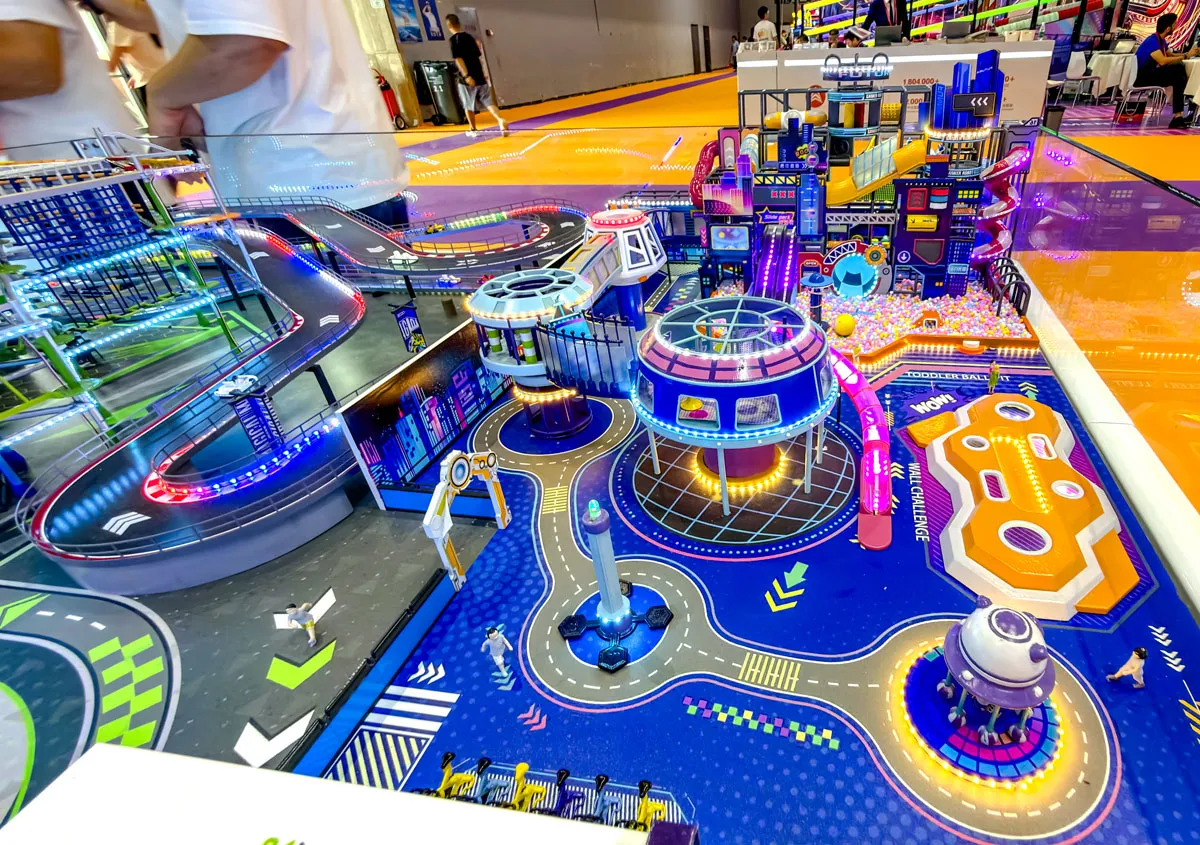
A main court may connect naturally with a slam-dunk track because both support active jumping. A foam pit can become the destination at the end of a skill route. Interactive wall games can add another objective without forcing visitors to leave the active-play zone.
This is where trampoline park manufacturing needs to respond to the whole project rather than a fixed catalogue. Haiber’s company profile describes services extending from planning and design through R&D, production, construction, installation and after-sales support.
A mixed-attraction concept combines trampoline activities with other play formats to serve a broader range of visitor preferences.
Planning Model | Main Strength | Best Fit |
Trampoline-focused park | Clear jumping and sports identity | Venues centered on active jumping |
Trampoline plus interactive play | More varied repeat experiences | Group and social play |
Multi-attraction family center | Wider activity mix | Family entertainment centers |
Haiber’s broader indoor-play portfolio includes interactive products, indoor playground structures and other commercial attractions, so operators can connect trampoline zones with complementary experiences.
Operational planning means designing equipment and circulation so staff can supervise, inspect and maintain the venue efficiently.
A layout can become difficult to operate if staff cannot reach important areas or isolate a section for maintenance. Access points, padding, boundaries and transitions should therefore be considered during design rather than after installation.
Haiber states that its trampoline park finished equipment has been tested as qualified to ASTM F2970. Its indoor-playground material information also lists 10 core materials that have passed SGS testing.
Family entertainment center integration means planning the trampoline area as one part of a broader visitor experience rather than as a self-contained island.
A trampoline zone may attract highly active users, while the rest of the venue can provide interactive or indoor-play experiences for visitors with different preferences.
When buyers evaluate family entertainment center equipment, they should ask how each attraction contributes to the whole visit. The trampoline zone needs its own identity, but it should also connect naturally with neighboring activities and circulation routes.
Custom trampoline park design adapts equipment dimensions, attraction placement and circulation to the actual building.
Columns, ceiling conditions, entrances and irregular floor shapes can all influence the final layout. Haiber’s turnkey design process includes overall planning, concept design, spatial planning, themed design, production and installation, allowing constraints to be addressed before manufacturing begins.
This is especially useful when an existing commercial space is being converted into an entertainment venue rather than constructed around a predetermined trampoline layout.
A project partner is a manufacturer that can coordinate design intent, production details, installation requirements and long-term operating needs.
Haiber Play reports 26 years of amusement-park construction experience and provides services across planning, design, R&D, production, construction, installation and after-sales support.
That matters because trampoline courts, padding, supporting structures and adjacent attractions eventually need to operate as one environment. Buyers should therefore compare not only product appearance, but also layout logic, manufacturing capability and installation coordination.
Start with visitor flow and zoning. Equipment selection is more effective after the operator knows how guests should enter, circulate and move between different activity areas.
Haiber’s trampoline solutions include main court trampolines, angled trampolines, foam pits and slam-dunk tracks, while broader projects can integrate interactive and indoor-play attractions.
Neither model is universally better. A trampoline-focused park creates a clearer jumping identity, while a mixed venue can serve visitors with a wider range of activity preferences.
Custom design helps equipment fit actual building conditions, circulation requirements, surrounding attractions and operational needs instead of forcing a standard layout into the available space.
ASTM F2970 addresses the design, manufacture, installation, operation, maintenance, inspection and major modification of commercial or institutional trampoline courts.
Haiber Play provides planning, design, R&D, production, construction, installation and after-sales support together with commercial trampoline and other indoor entertainment equipment.
Effective trampoline park planning begins with experience design rather than an equipment checklist. Strong layouts connect a flexible core court with complementary activities, clear movement paths, workable supervision and venue-specific zoning.
Operators should also consider how the trampoline area fits into the wider commercial concept. By coordinating design, manufacturing and installation as one project, Haiber Play can help buyers turn individual trampoline features into a more coherent commercial entertainment environment.
ASTM F2970-25 – Standard Practice for Design, Manufacture, Installation, Operation, Maintenance, Inspection and Major Modification of Trampoline Courts
https://store.astm.org/f2970-25.html
ASTM F770-24 – Standard Practice for Ownership, Operation, Maintenance, and Inspection of Amusement Rides and Devices
https://store.astm.org/f0770-24.html
IAAPA – Ride Safety Regulation
https://iaapa.org/safety/ride-safety-regulation

 English
  français
  Deutsch
  Español
  italiano
  русский
  português
  العربية
  Türkçe
  Jawa
Jawa