Hello everyone, I am Nan Lei, the Brand Operations Manager at Haiber.
Many people ask me why I have such confidence in our company and the industry. Let me be completely frank with you: it is because we have the substance to back it up. In the amusement industry, safety is the bottom line, and professionalism is our source of confidence. It is precisely through such a professional team that Haibeier perfects every single detail. Moving forward, we will continue to leverage this professionalism to deliver amusement experiences that are safer, more entertaining, and infused with cultural warmth.
A successful indoor playground is determined long before manufacturing begins. Once production starts, structural changes become expensive, project timelines extend, and installation challenges multiply. The most efficient projects complete all major design decisions before issuing production drawings.
Whether you're developing a family entertainment center, shopping mall playground, or children's activity center, this guide outlines the 12 engineering and operational decisions that should be finalized before your commercial indoor playground equipment enters production. By working closely with an experienced indoor playground supplier, investors can reduce project risks, control costs, and ensure a smoother path from design approval to grand opening.
Every design decision should support your business objectives—not the other way around.
Before discussing equipment layouts, determine:
Who is your primary customer?
What age groups will you serve?
Will revenue come from admission tickets, memberships, birthday parties, food service, or multiple income streams?
Is the project located inside a shopping mall, retail center, hotel, or standalone building?
For example:
| Business Model | Design Priority |
|---|---|
| Family Entertainment Center | Longer visitor stay and diverse attractions |
| Shopping Mall Playground | High visual impact and efficient circulation |
| Community Children's Center | Flexible play and educational activities |
| Resort or Hotel Playground | Compact premium experience |
Professional playground design begins with operational strategy, not equipment selection.
One of the most common reasons for design revisions is incomplete site information.
Before manufacturing begins, verify:
Actual usable floor area
Structural column locations
Ceiling clear height
Emergency exit positions
HVAC ducts
Fire sprinkler systems
Windows and natural lighting
Loading doors for equipment delivery
These architectural constraints directly affect the design of commercial indoor playground equipment, especially multi-level structures, tube slides, and climbing towers.
Separating children by developmental stage improves both safety and customer satisfaction.
Typical zoning includes:
Soft sensory play
Foam obstacles
Low slides
Parent interaction area
Ball pools
Small climbing systems
Role-play houses
Interactive games
Rope courses
Volcano climbing
Ninja challenges
High slides
Interactive digital attractions
Clear age segmentation also reduces congestion and minimizes conflicts between younger and older children.
A playground should be designed for people movement rather than simply maximizing equipment density.
Capacity planning considers:
Maximum simultaneous visitors
Parent-to-child ratio
Queue formation
Party room access
Emergency evacuation routes
Waiting areas
Good circulation creates:
Better visibility
Easier supervision
Higher operational efficiency
More enjoyable customer experience
Poor circulation often leads to crowding even when the facility appears large.
Longer visits generally create higher revenue opportunities.
Instead of purchasing isolated attractions, successful projects integrate complementary activities.
Common combinations include:
Multi-level soft play
Giant ball pools
Spiral tube slides
Trampoline areas
Ninja obstacle courses
Interactive projection games
Rope adventure courses
Donut slides
Climbing walls
Role-play villages
The attraction mix should encourage visitors to naturally explore multiple zones throughout their visit.
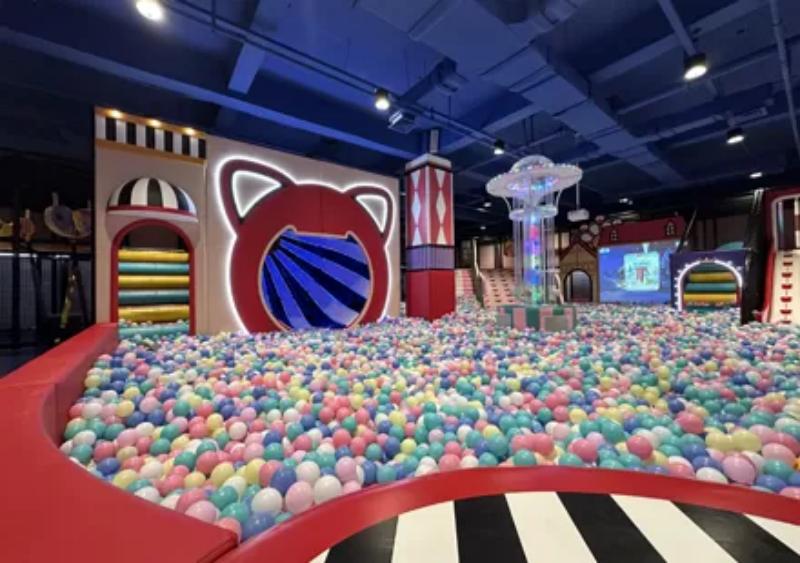
Today's indoor playgrounds compete on experience as much as equipment.
Popular themes include:
Space exploration
Jungle adventure
Ocean world
Candy kingdom
Futuristic city
Castle fantasy
Nature discovery
Beyond aesthetics, consistent visual identity supports:
Brand recognition
Social media sharing
Repeat visits
Marketing campaigns
Birthday party bookings
Custom theming should integrate with the equipment rather than being added afterward.
Parents expect clear visibility throughout the playground.
During design, consider:
Open sightlines
Transparent barriers
Resting areas overlooking play zones
Emergency access routes
Equipment spacing
Impact zones around slides
Soft flooring transitions
Professional layouts balance exciting play experiences with effective supervision.
Maintenance should never be an afterthought.
Ask your indoor playground supplier:
Can major components be removed without dismantling the entire structure?
Are access panels included?
How are high-level nets inspected?
Can worn slides or obstacles be replaced individually?
How will daily cleaning be performed?
A maintenance-friendly design reduces long-term operating costs and minimizes downtime.
Many modern playgrounds include:
Interactive games
LED lighting
Projection systems
Audio equipment
Security cameras
Access control
POS systems
These systems should be coordinated with:
Fire sprinklers
Smoke detectors
Emergency lighting
HVAC
Building columns
Ceiling access
Early coordination prevents costly modifications during installation.
Material selection affects safety, durability, and maintenance.
Important considerations include:
Steel frame specifications
Foam density
PVC quality
Net strength
Plastic rotational molding quality
Fire-retardant materials
Flooring systems
Fastener corrosion resistance
A reputable indoor playground supplier should provide documentation supporting compliance with applicable playground safety standards and material certifications required in your target market.
Production should begin only after every stakeholder approves the design.
Typical drawing package includes:
Overall layout
Elevation views
Structural details
Component numbering
Installation sequence
Electrical locations
Theme graphics
Material specifications
This "design freeze" minimizes production errors and reduces change orders.
Late modifications often increase both manufacturing costs and delivery times.
Successful projects begin preparing for installation well before equipment arrives.
Key preparation items include:
Flooring completion
Power availability
Internet connection
Delivery access
Construction schedule coordination
Staff recruitment
Operational manuals
Cleaning procedures
Safety inspections
Trial operation
Opening day should be viewed as the final stage of project execution rather than the beginning of operational planning.
Minor decorative changes may still be possible, but structural modifications often require redesign, additional manufacturing, and extended lead times. Finalizing the design before production is the most cost-effective approach.
Most suppliers will request:
CAD floor plan
Ceiling height
Column locations
Entrance dimensions
Target customer age
Budget
Preferred theme
Planned opening date
Local safety requirements
Providing complete information leads to a more accurate design proposal.
Many investors prioritize equipment quantity over visitor experience. Effective layouts focus on circulation, visibility, age zoning, operational efficiency, and future maintenance rather than filling every available space.
Commercial playground success is determined during the design phase—not on installation day. From venue positioning and circulation planning to safety coordination, material selection, and production drawings, each decision directly influences construction efficiency, operational performance, and long-term profitability.
By partnering with a knowledgeable indoor playground supplier and resolving these 12 critical design decisions before manufacturing begins, investors can streamline production, avoid unnecessary revisions, and create commercial indoor playground equipment solutions that deliver exceptional visitor experiences and sustainable business growth.

 English
  français
  Deutsch
  Español
  italiano
  русский
  português
  العربية
  Türkçe
  Jawa
Jawa